


Moto Leather Jacket Canada
The call of the road is clearly not for those who trundle along in life’s slow lane. Some of us ignore it; most do not even hear it. Yet even good public-transport citizens occasionally crave the thrill of the open highway, if only metaphorically. This is where the biker jacket comes in.
There is the faint aura of law infringement in the biker-inspired jackets of the fall/winter 2013 collections. Hussein Chalayan’s impractically thin, form-fitting one would protect nobody from the ravages of road burn, and Rodarte’s flapping white one with studded pockets is only distantly related to anything Marlon Brando wore. The Diesel and Givenchy jackets look the part, however, as does the Alexander Wang vest, which also has the virtue of showing off one’s “I Love Mom” tattoo. Jean Paul Gaultier celebrated the motorcycle jacket with numerous variations on the classic. Sleeveless and dropped to the knee, it became a dress. Paired with a frothy long skirt, it suddenly made the wearer less debutante and more Joan Jett.
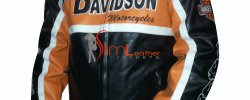
As a Frenchman, Gaultier is naturally sensitive to history, and the vestimentary codes of the biker jacket certainly qualify it as an iconic piece. Leather jackets had been worn by military and aviation officers since the early 1900s, but it wasn’t until 1928 that the modern biker jacket was introduced by New York entrepreneur Irving Schott. It was dubbed the “Perfecto, ” after Schott’s favourite cigar, and retailed for $5.50 at Harley-Davidson distributors. The world discovered it on Marlon Brando in The Wild One (1953), and American high-school principals, sensing trouble, immediately slapped a ban on it. “Of course we were worried at first, ” emails Jason Schott, Irving’s great-grandson. “We never expected sales to skyrocket as a result.” James Dean was a Perfecto devotee, as were others who sought rebel credentials, like the Ramones and Blondie’s Debbie Harry, one of its first female fans. “My great-grandfather designed jackets for the military and the NYPD, so they had to be functional, ” explains Schott. “We keep that in mind in all our designs.” Irving designed every detail of the original Perfecto for optimal roadworthiness: It was made of stiff black horsehide that protected the rider from falls, the belt at the waist and diagonal zips across the front and at the wrists stopped the wind from penetrating, and the button-snap epaulettes held gloves.
More on the leather jacket on the next page...
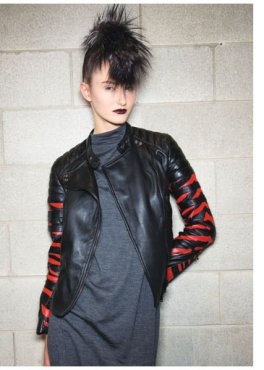 As if by telepathy, British manufacturers Belstaff and Barbour also came up with protective motorcycle gear during the interwar period. Belstaff’s legendary Roadmaster and Trialmaster were made of thick waxed cotton and featured quilting, zippers down to the crotch and on the outside of the wrists and ribbed leather on the elbows. Belstaff, which has now switched gears from highway to runway under designer Martin Cooper, lays claim to a clientele of ne plus ultra rebel icons like Che Guevara, Lawrence of Arabia and Steve McQueen.